


Kumi's Review
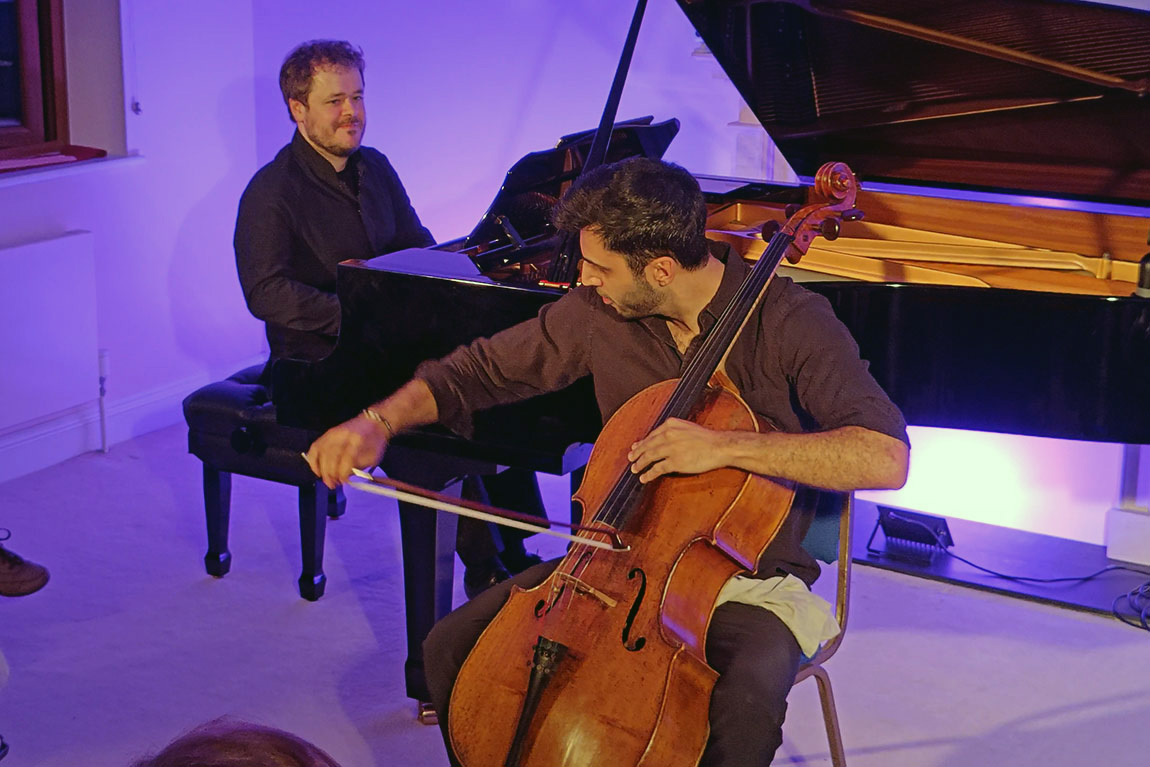
One of the advantages of engaging artists of the calibre and reputation of Kian Soltani and Benjamin Grosvenor s the definite certainty that they will deliver the highest quality of performance you could ever expect. Their confidence, experience, easy-going and relaxed approach to the audience makes you think that nothing is going to go wrong, and all we need to do is wait for what is going to unfold in front of us. And that was exactly what happened. Here I don’t even have to discuss Schubert’s Arpeggione Sonata and Franck’s Violin Sonata (arranged for cello); they were magnificent and deeply engaging. The sonority of both instruments was heavenly and swept us through the dreamy world and emotional imagination.
What made us sit up with great intensity was the vast contrast between these two romantic works and the remaining pieces of the programme; totally unpredictable – particularly Habil Sajahy by Frangiz Al-Zadeh, a living female composer from Azerbaijan.
As they began, the anticipation grew in the audience, then we were all taken aback by the eccentricity of the music. When it achieved a ‘spiritual trance’ like climax, we were willingly swallowed by the creation of the sounds we never imagined. Benjamin did everything on the piano except playing the piano - not something he was trained to do in his entire life! In an email he sent to me prior to the recital, he said, “the strings have to be hit lightly with some felt and rubber sticks; I pluck the strings with my fingers, and with a plectrum; a pearl necklace is placed on the strings for a particular effect; I hit the bass strings with the palms of my hands”. Benjamin later told me that the inside of our Yamaha is structurally different from Steinway (which he plays both at home and at Wigmore Hall), therefore he had to re-learn the new position entirely for this evening; a challenging task because he did not have any prior muscle memory.
It was a brave choice of repertoire, which they were to play at the rather conservative Wigmore Hall following Breinton, but exactly what comes alive in our intimate setting!
Programme Notes
Schubert: Sonata in A
When Franz Schubert composed his Sonata in A minor in 1824, he wrote it for an instrument that was already slipping into obscurity. The arpeggione was a six-stringed, fretted instrument played with a bow and shaped like a cello. It combined the tuning and range of the guitar with the playing position of a bowed string instrument. The sound was delicate and lyrical, but the instrument’s design proved impractical, and within a few years it had disappeared from use. Schubert’s sonata, however, lived on, and has become one of the most cherished works in the cello repertoire through later transcriptions.
Schubert wrote the sonata during a remarkably productive period in his life. In the same year he completed the Octet and began work on several of his finest quartets. Illness and uncertainty about his future shadowed his days, yet his music radiated serenity and imagination. The Arpeggione Sonata combines melodic abundance with intimacy, and in its quiet way reflects both hope and melancholy.
The first movement begins with a long, singing phrase in the cello, soon joined by a piano line of equal beauty. The two instruments are treated as equals throughout, sharing and echoing one another’s material in a spirit of chamber dialogue. The music moves freely through distant keys, as if exploring memory and longing rather than following a strict plan.
The slow movement, in E major, is a song without words. Its calm, flowing melody evokes the inner stillness that lies at the heart of Schubert’s lyric style. The piano provides a gentle web of arpeggios while the cello sings with quiet intensity. In the finale, marked Allegretto, a dancing rhythm returns, recalling the folk character of Austrian Ländler. Yet even in its lightness there is wistfulness, as if the composer could never entirely forget the shadows that surrounded him.
Today the Arpeggione Sonata remains one of Schubert’s most loved chamber works. Its fragile grace and emotional transparency give it an enduring place in recital programmes, both as a work of poetry and as a testament to the expressive partnership between string instrument and piano.
Ali-Zadeh: Habil Sajahy
Frangiz Ali-Zadeh is a leading figure in contemporary music from Azerbaijan. Born in Baku, she was trained in the classical Soviet tradition but has always remained deeply connected to the folk and spiritual heritage of her country. Her music often blends Western modernist techniques with the microtonal scales, modal inflections, and ornamented melodies of traditional Azerbaijani mugham.
Habil Sajahy, composed in 1999 for cello and piano, is dedicated to the memory of Habil Aliyev, the celebrated performer of the kamancha, a traditional bowed string instrument central to Azerbaijani music. The title can be understood as “in the manner of Habil.” The work seeks to capture the expressive essence of Aliyev’s artistry rather than to imitate the sound of the kamancha directly.
The cello, with its singing tone and ability to slide between pitches, becomes a voice of lament and remembrance. It moves freely between long sustained notes, sighing ornaments, and anguished cries. The piano part alternates between sparse, percussive textures and shimmering resonance, suggesting the drone and rhythmic underpinning of mugham performance.
Rather than adhering to classical form, the piece follows an organic, improvisatory shape. It begins in stillness, as if summoning a memory, builds to an impassioned climax, and subsides again into quiet. The work’s language is deeply expressive yet economical. Every gesture feels essential.
In Habil Sajahy Ali-Zadeh pays tribute not only to a great musician but to the idea of music as a spiritual act of remembrance. The piece invites listeners into a world where lament becomes transformation and where the boundaries between tradition and modernity dissolve.
Wallen: Dervish
Errollyn Wallen is one of Britain’s most distinctive and wide-ranging composers. She writes for opera houses, orchestras, choirs, and chamber ensembles, yet she also performs as a singer and pianist of her own songs. Her music is rooted in classical craft but draws freely on jazz, minimalism, and popular idioms. She often describes her work as “classical, but inclusive.”
Dervish, written in 2001 for cello and piano, takes its title from the Sufi mystics whose whirling dance symbolises a search for spiritual ecstasy. Wallen translates this idea of rotation and momentum into musical terms. The piano sets up a rhythmic pulse that turns upon itself like a spinning wheel, while the cello traces circling melodic patterns above it.
The piece is brief, lasting around six minutes, yet within that span it creates a vivid sense of movement. The energy builds and releases in waves, alternating between breathless motion and moments of suspension. The harmonic language is modal, coloured by syncopation and hints of jazz phrasing. The music seems always to turn back upon itself, suggesting that spiritual discovery lies not in progress but in repetition and trance.
Dervish stands at the centre of this recital as a burst of kinetic life. Its physical energy contrasts with the introspection of Ali-Zadeh and the lyrical expansiveness of Schubert and Franck, offering a modern voice that celebrates rhythm and freedom as paths toward transcendence.
Franck: Sonata in A
César Franck’s Sonata in A major is one of the most enduring masterpieces of the late Romantic era. Composed in 1886 as a wedding gift for the violinist Eugène Ysaÿe, it was soon arranged for cello and piano with the composer’s approval. The work exemplifies Franck’s mature style, combining rich harmony, cyclical structure, and a sense of spiritual aspiration.
Franck, born in Liège but active for most of his life in Paris, was renowned as an organist and teacher. His music reflects both the grandeur of the French organ tradition and the emotional intensity of German Romanticism. The A major Sonata unites these influences within a design that allows each movement to grow from the same thematic seed.
The first movement begins with a melody of serene simplicity. It unfolds with quiet confidence, the piano and cello exchanging phrases in balanced partnership. The second movement introduces contrast: a stormy Allegro full of rhythmic drive and sweeping modulations. Its intensity is relieved by a lyrical middle section before the turbulence returns.
The third movement, a Recitative and Fantasia, serves as a moment of reflection. The cello declaims freely over sparse piano harmonies, as if recounting a personal narrative. This leads without pause into the radiant finale, a canon between the two instruments in which each voice imitates the other. The theme, noble and joyful, transforms earlier motifs into a song of reconciliation. The sonata ends with calm assurance, resolving its journey from introspection to affirmation.
The A major Sonata remains one of the cornerstones of the cello and piano repertoire. Its combination of structural logic and emotional depth has inspired generations of performers. Listeners today can still sense in it the idealism of a composer who believed that music could express unity, faith, and devotion.
Kian's Biography

Hailed by The Times as a “remarkable cellist” and described by Gramophone as “sheer perfection”, Kian Soltani’s playing is characterised by a depth of expression, sense of individuality and technical mastery, alongside a charismatic stage presence and ability to create an immediate emotional connection with his audience. He is now invited by the world’s leading orchestras, conductors and recital promoters, propelling him from rising star to one of the most talked about cellists performing today.
Benjamin's Biography

British pianist Benjamin Grosvenor has an acclaimed international career as a soloist and chamber musician, which is reflected in his extensive discography on Decca Classics.
During the 2024/2025 season Benjamin makes his debut with the NHK Symphony/Paavo Jarvi, Bamberger Symphoniker and Dallas Symphony Orchestras. Benjamin also returns to Boston/Andris Nelsons, Montreal and Bern Symphony Orchestras and plays a UK tour with the London Philharmonic Orchestra and Andrey Boreyko.