


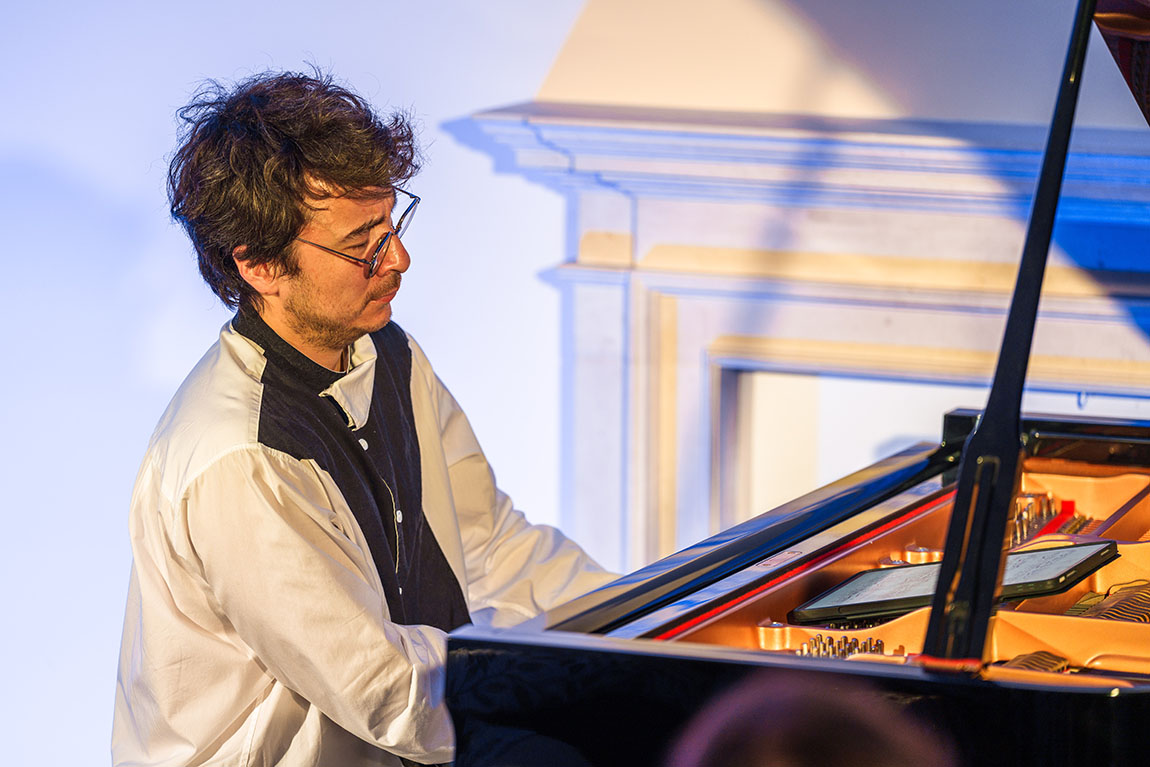


Kumi's Review
The first half of the programme was a flawless stream of miniature gems; a selection of beautiful works by Bach and Brahms that are often heard through the hands of other pianists and composers, and short works by Kurtág thrown in between them. It travelled across times, musical styles and personal boundaries. You do not come across this distinctive programme format very often and this was certainly new to Breinton audiences, but it absolutely grabbed their interest. Samson mentioned that performers, metaphorically speaking, “steal someone else’s soul” to make it their own. That is what Busoni created, taking Bach’s and Brahms’ Choral Preludes, and Alfred Cortot did with Bach’s Arioso. And Samson created his own voice connecting these miniature gems.
From the title Perpetual Motion you’d imagine something quite mechanical, repetitive and monotonous. However, Kurtág’s Perpetuum Mobile was nothing but that. It had depth, energy, density, textures and full dynamic range. Samson presented it in an impactful way, almost by catching the audience off guard, to go straight into the sacred zone of Bach’s Arioso, whose divine melody he explicitly expressed. The inward world of Brahms’ Choral Preludes No. 4 and No. 5 were played next with exquisite delicacy, while No. 11 was weighty and had majestic yet intimate beauty. These choral preludes were the last compositions Brahms ever wrote in 1896, one year before his death. It is quite heartfelt that this piece was titled “O world, I must leave you”. Samson skillfully navigated the audience through this spiritual, intimate yet quietly powerful pieces to reach Kurtág’s A Voice in the Distance, which closed the first half.
Brahms composed Piano Sonata No. 3 when he was 20 years old. How incredibly fortunate it was to experience Brahms’ youthful and passionate composition, and his very last one, in one setting. This monumental symphonically-scaled sonata was spell binding, and with Samson’s technical rigour, it came alive and held the audience tight. It was like experiencing an intense drama unfolding around us.
Responding to the enthusiastic applause, Samson came back to play two encores: Schubert’s Impromptu No. 2, Op. 90, followed by Brahms-Busoni, Chorale Prelude No. 10, Op. 122. The latter piece was one of the recital piece – it must be Samson’s favourite.
Programme
- Kurtág
- Perpetuum mobile from Játékok, Book I
- Scraps of a colinda melody – faintly recollected from Játékok, Book III
- Bach–Cortot
- Arioso from Keyboard (Harpsichord) Concerto No. 5 in F minor, BWV 1056
- Bach–Busoni
- Ich ruf zu dir, Herr Jesu Christ, BWV 639 (from Orgelbüchlein)
- Brahms–Busoni
- Chorale Prelude Herzlich tut mich erfreuen from Eleven Chorale Preludes, Op. 122 No. 4
- Chorale Prelude Schmücke dich, o liebe Seele from Eleven Chorale Preludes, Op. 122 No. 5
- Chorale Prelude Herzlich tut mich verlangen from Eleven Chorale Preludes, Op. 122 No. 10
- Chorale Prelude O Welt, ich muss dich lassen from Eleven Chorale Preludes, Op. 122 No. 11
- György Kurtág
- A voice in the distance from Játékok, Book V
- Brahms
- Theme and Variations in D minor, Op. 18b
- 3rd Sonata
Samson's Biography
The 2024/25 season saw Samson release his debut solo album on Linn Records, which received acclaim reviews in The Guardian, BBC Music Magazine, Diapason, and Scherzo.
Recent highlights have included a debut with the London Philharmonic Orchestra (Beethoven Piano Concerto No. 3), solo recitals at Wigmore Hall and Guggenheim Bilbao, concerts with the Philharmonia Orchestra with Gergely Madaras (Scriabin’s Prometheus) and Maxim Emelyanychev (both Brahms Piano Concertos in one evening), and a concert with Münchener Kammerorchester and Enrico Onofri. He also collaborated with acclaimed American artist Richard Serra at the Gagosian Gallery, where he performed Messiaen’s Quatuor pour la fin du temps.
Samson frequently collaborates with pianist Pavel Kolesnikov, and this season the duo make their debuts at Bozar in Brussels, Saffron Hall, Festival Bach de Montreal, and returns to the Muziekgebouw in Amsterdam and Wigmore Hall. These dates follow appearances last season at Carnegie Hall, Berlin's Konzerthaus, Rotterdam's De Doelen, and the Muziekcentrum de Bijloke in Ghent. In April 2025 the duo gave 2 concerts in tribute to artist David Hockney, at the Louis Vuitton Foundation in Paris.
Lauded for his originality and "inexhaustible imagination’" Samson has performed in venues and festivals around the world including the Barbican, Wigmore Hall, Royal Festival Hall and Queen Elizabeth Hall, Aldeburgh festival, Théâtre de la Ville and Salle Gaveau in Paris, Berlin’s Konzerthaus, and Verbier Festival. In 2023, he was the first-ever classical musician to perform for the opening of the Münchner Sicherheitskonferenz (Munich Security Conference) in front of the world’s most important political leaders.
He was born in Kazakhstan and is based in London.
Programme Notes
This evening’s programme is built around connection. Some connections are direct: Bach’s organ and harpsichord music is heard in piano arrangements, Brahms’s organ chorale preludes are brought to the keyboard by Busoni, and Brahms himself reworks chamber music as a solo piano variation set. Other connections are more oblique. Kurtág’s miniatures, taken from Játékok, interrupt and frame the older music. They are small pieces, not slight ones. In this programme they sharpen the ear before and after Bach and Brahms, asking us to notice how much can be carried by a single line, a short gesture, or a remembered fragment.
György Kurtág began Játékok, meaning “Games”, in the 1970s. The pieces began partly as music for young players, with an emphasis on physical freedom at the keyboard and experiment. Yet they are not merely teaching pieces. Many are tributes, memorials, recollections, or compressed studies in musical character. Their brevity is part of their meaning. Instead of developing ideas at length, Kurtág often gives us a concentrated object whose resonance depends on touch, timing, and the space around it.
Perpetuum mobile, from Book I of Játékok, opens the recital with motion. A perpetuum mobile is a piece driven by continuous movement, and Kurtág treats that idea directly. The music asks the pianist to use the full keyboard with energy and immediacy. Heard at the start of this programme, it clears the ground. It also introduces one of the evening’s recurring themes: the piano as an instrument of physical action, not only of melody and harmony.
Bach’s Arioso, arranged by Alfred Cortot from the slow movement of the Harpsichord Concerto No. 5 in F minor, BWV 1056, brings a different kind of movement. The original concerto was written for harpsichord and strings, but the slow movement has long had a separate life. Its melody has the character of an instrumental song, poised above a steady accompaniment. Cortot presents it for the modern piano without trying to turn it into something grander than it is. The name Arioso suits the piece: it is not an aria, but it sings.
Kurtág’s Scraps of a Colinda Melody, Faintly Recollected comes from Book III of Játékok and carries the subtitle Hommage à Farkas Ferenc. A colinda is a Romanian winter song, and Farkas Ferenc was one of Kurtág’s teachers. The title is careful: not a colinda fully presented, but scraps, and not clearly remembered, but faintly recollected. The piece is about memory as much as melody. It suggests how a tune may survive as a contour, a rhythm, or a colour rather than as a complete object.
This kind of musical remembering leads naturally to Bach’s Ich ruf zu dir, Herr Jesu Christ, BWV 639, from the Orgelbüchlein. Bach’s original is one of his best-known chorale preludes for organ. The chorale melody unfolds above a gently moving accompaniment, with the lower voice giving the music a calm tread. Ferruccio Busoni’s piano transcription respects the inward scale of the piece. His aim is not simply to copy organ sound on the piano, but to find a pianistic equivalent for contrapuntal clarity, sustained line, and devotional stillness.
The first group of Brahms-Busoni chorale preludes continues this inward world. Brahms wrote his Eleven Chorale Preludes, Op. 122, for organ in 1896, late in his life. They were published after his death. Busoni later transcribed a selection for piano. The two heard here before the D minor variations, Herzlich tut mich erfreuen and Schmücke dich, o liebe Seele, show Brahms working on a small scale, with great restraint. These are not dramatic concert pieces. They are studies in how a chorale melody can be supported, coloured, and quietly transformed. Brahms had a lifelong respect for older musical forms, especially counterpoint, variation, and chorale writing. In the Op. 122 preludes, that respect is not antiquarian. The harmony is unmistakably his own, often warm, often shadowed, and attentive to inner voices. On the piano, through Busoni’s transcription, the listener may hear the music less as organ sonority and more as part writing.
Brahms’s Theme and Variations in D minor, Op. 18b, is another act of transformation. It is based on the second movement of his String Sextet No. 1 in B flat major, Op. 18, composed in 1860. The piano version is not a casual reduction. It reimagines the movement as a self-contained work for one player, preserving the sober theme and the sequence of variations while changing the means by which the music speaks.
The theme is grave but not heavy. Its shape is clear, and that clarity is essential because the variations that follow depend on the listener’s memory of it. Brahms does not vary the theme through display alone. He changes texture, density, figuration, and register, allowing the music to gather force without losing its outline. Some variations press forward through increasingly active note values; others draw attention to harmony or to the spacing of voices. The result is a work that feels both disciplined and expressive.
The return to Brahms-Busoni after Op. 18b changes the atmosphere. Herzlich tut mich verlangen and O Welt, ich muss dich lassen come from the later part of the Op. 122 set. The titles belong to Lutheran chorale tradition, and both have associations with leave-taking, longing, and mortality. It would be too simple to read them only as personal farewell, but the late date of the pieces and their quiet concentration make that association hard to ignore. Brahms’s writing avoids display. The music seems to listen inwardly.
O Welt, ich muss dich lassen, the last of the eleven chorale preludes, has particular weight as the end of Brahms’s final published work. Its title means “O world, I must leave you”. The setting is plain, but not empty. The emotional force lies in the spacing of the chorale, the gentle movement around it, and the absence of excess. Busoni’s transcription allows the piano to speak the piece with intimacy, using touch, pedalling, and voicing to suggest continuity.
Kurtág’s A Voice in the Distance, from Book V of Játékok, closes the first half. It is dedicated to Alfred Schlee on his 80th birthday. The title fits its place in the programme. After Bach and Brahms, both heard partly through transcription and memory, Kurtág offers music that seems to come from afar. The “voice” need not be identified. It may be a musical line, a recollection, or a presence suggested by sound rather than stated in full. The piece leaves the first half not with a conclusion in the usual sense, but with an image of distance.
After the interval comes Brahms’s Piano Sonata No. 3 in F minor, Op. 5. It was composed in 1853, when Brahms was twenty, and it is the last of his three piano sonatas. It is also the largest. In five movements rather than the usual three or four, it treats the piano almost orchestrally at times, with thick textures, wide registers, and strong contrasts of character. Yet it is not only a work of force. Much of its interest lies in the way Brahms holds together large structures through recurring ideas, tonal relationships, and a strong sense of narrative pacing.
The first movement, Allegro maestoso, begins with a broad, commanding gesture. The music has the scale and seriousness often associated with Beethoven, but the language is early Brahms: impetuous, full-textured, and rhythmically alert. The movement contrasts stormy material with more lyrical writing, though the lyrical passages do not simply relax the tension. They are drawn into the same argument. Brahms’s handling of sonata form here is ambitious. He gives the impression of a young composer testing how much weight the form can carry.
The second movement, Andante espressivo, provides the emotional centre of the sonata. It is prefaced in the score by lines from a poem by Sternau, asking whether two hearts can unite in love and hold each other in bliss. The movement is not a simple song without words, though it often sings. Its breadth comes from the way Brahms expands the lyrical material into a large, sustained structure. The writing asks for warmth but also patience. It moves through episodes of intimacy, fullness, and quiet return, and its length gives it unusual importance within the sonata as a whole.
The Scherzo, marked Allegro energico, brings a more public kind of energy. Its rhythm is firm, and its character is forceful. The trio offers contrast, but not escape; it belongs to the same world of muscular piano writing. Brahms’s scherzos often combine drive with careful construction, and this one is no exception. The movement has brilliance, but its brilliance is grounded in rhythm and structure rather than decoration.
The fourth movement, Intermezzo. Andante molto, is one of the most unusual parts of the sonata. It is brief and subdued, and it bears the character of a retrospective pause. Sometimes described as a kind of Rückblick, or backward glance, it recalls the world of the slow movement without repeating it directly. Placed between the Scherzo and Finale, it changes the sonata’s proportions. Rather than moving straight from action to conclusion, Brahms inserts a moment of reflection. In doing so, he deepens the sense that this sonata is not merely a sequence of contrasting movements, but an unfolding drama.
The Finale, marked Allegro moderato ma rubato, must gather the threads of a very large work. Its marking already suggests flexibility: moderately fast, but with rhythmic freedom. The movement combines urgency with episodes of lyricism, and it returns to the sonata’s larger concerns of conflict, memory, and resolution. Brahms does not end by simplifying the music’s tensions too soon. The conclusion has to be earned through scale and persistence.
Heard after the first half’s miniatures, chorales, and transcriptions, the sonata takes on a particular role. It is the evening’s largest statement, but it also belongs to the same world of transformation. Brahms absorbs the past into a new language; Busoni later reimagines Brahms and Bach for the piano; Kurtág distils memory into brief gestures. The programme therefore moves between compression and expansion, between single voices and large forms. It ends with Brahms at his most ambitious as a young piano composer, but with the ear already prepared to hear how much can be contained in a line, a fragment, or a remembered song.
© 2026 Breinton Recital Society